The Oakland Hills Fire (also known as the Tunnel Fire) burned through Oakland and Berkeley, California, in October 1991. It killed 25 people and destroyed over 3,800 residences in hills that had burned before. Almost 800 structures ignited in its first hour. Oakland’s rebuilding raised questions that communities at the wildland-urban interface still face: which standards apply to new and rebuilt homes, how quickly residents can return, who decides how a neighborhood changes, and who pays for those changes.

Shortly after noon on Saturday, October 19, 1991, a brush fire broke out on a steep slope at the end of Temescal Canyon, in the hills above Oakland, California. Firefighters stopped it at two acres and declared it under control early that afternoon. What started it was not determined.
The East Bay was in its fifth year of drought. A freeze the previous December had killed large amounts of the lighter brush and eucalyptus, and a hot, dry Diablo wind from the east was forecast for Sunday.
On Sunday morning, October 20, crews returned to check the burn area for hot spots. A firefighter was digging one out near the edge, and sparks carried into dry brush, which, in the words of the U.S. Fire Administration (USFA) report, “virtually exploded into flames.” At 10:58 a.m. an engine company called a full box alarm. Within 10 to 15 minutes the fire was burning buildings. Sixty-four minutes after the Sunday fire broke out, it was in the Rockridge district, more than a mile downwind, and almost 800 structures had ignited in that first hour.
Mutual aid brought 440 engine companies and 1,539 personnel from 250 agencies, some from as far as the Oregon border. Many of the engines from distant areas could not connect to Oakland’s hydrants. When California adopted a standard 2½-inch hydrant connection, Oakland and San Francisco kept their 3-inch connections, and the adapters for mutual aid units were stored in a warehouse. Because it was a Sunday, they were delayed until off-duty staff could open it. Even so, USFA concluded that water supply did not appear to be a deciding factor on the hills, since crews could make no progress against the flames before the hydrants went dry.
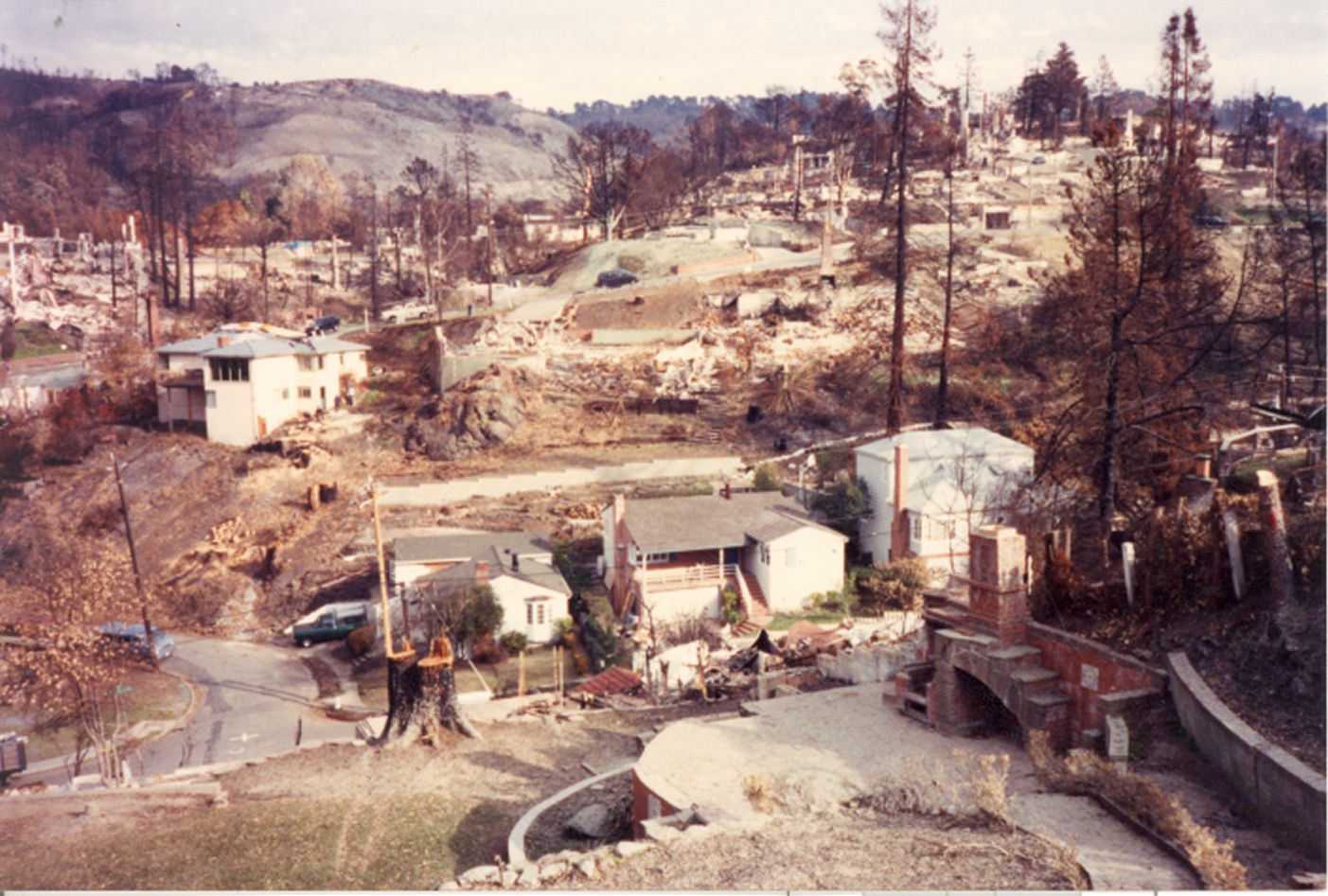
The fire stopped advancing when the wind died that evening and was declared contained on Tuesday morning, October 22. Twenty-five people died, among them Battalion Chief James Riley and Oakland Police Officer John Grubensky, who were killed trying to help residents escape. About 150 were injured. USFA counted 3,354 single-family homes and 456 apartment units destroyed and about 2,000 vehicles burned, and estimated that close to 10,000 people were left homeless. CAL FIRE, which counts the losses differently (see Notes on figures), puts the burned area at 1,600 acres.
Once the wind took hold of the fire, the losses depended on what was already in the hills. USFA’s analysis “strongly suggests that it was uncontrollable by conventional firefighting methods within the first few minutes.” Its report lists the same major factors for the 1970 fire in these hills and for this one, among them wood shingle roofs, no separation between houses and vegetation, steep terrain and difficult access.
Where the fire found its fuel
In the East Bay Hills, USFA wrote, “the fuel supply was an intimate mixture of natural trees, brush, and grass surrounding artificial structures and vehicles.” Many homes were built on platforms over the canyon walls or stepped down the hillside, often with living space below street level. In many places, trees formed a canopy over narrow roads. Untreated wood shake and shingle roofs were common, and USFA found that “no requirements for fire resistive roof coverings or walls were enforced.”
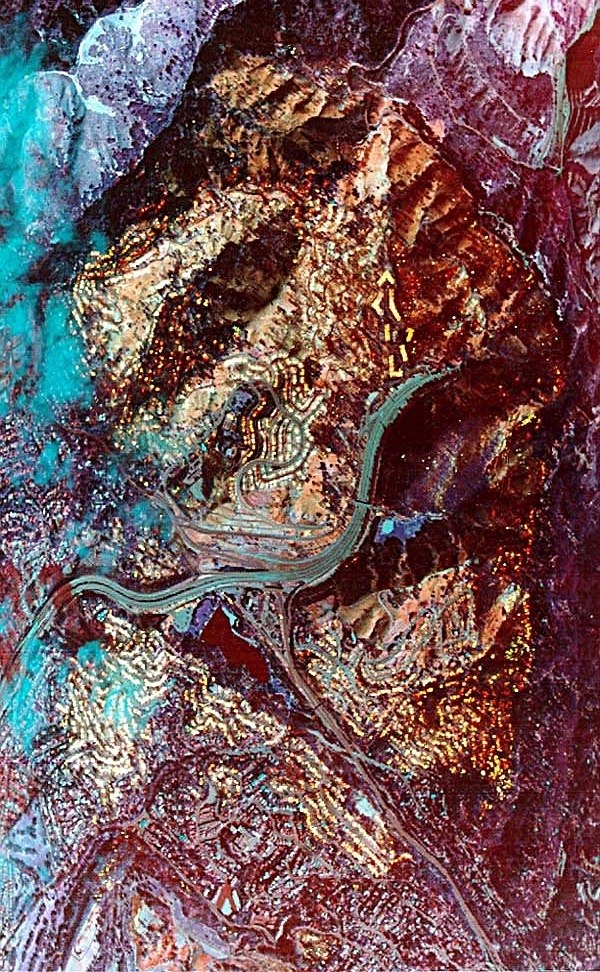
The fire got into houses in several ways. In many cases, wind-blown embers worked in under eaves, “readily igniting even tile-roofed structures.” Where walls and roofs held, heat radiating from burning trees and brush often ignited the interiors through the windows. The hillside homes fared worst: the vegetation carried the flames directly under their overhangs. Most houses were “totally consumed in less than an hour.”
Roofs made a visible difference. The National Fire Protection Association (NFPA) found that “the vast majority of the homes had combustible roofs.” Its investigators recorded more than one wood-shingled house that “was severely damaged or burned to the ground” while its clay-tile neighbors on either side were relatively undamaged. Tile performed much better at the edges of the fire, NFPA noted, where firefighters could put out embers before the roof caught.
Most major interface fires before this one had started in remote wildland and grown large before reaching homes. This one, USFA noted, “originated within a few hundred feet of occupied homes,” with firefighters already on the scene. After its first-hour run, the head of the fire advanced only three quarters of a mile over the next seven hours, through the densely built neighborhoods of Rockridge and Forest Park.
Fire had come through these hills before
USFA found the closest parallels in the 1923 and 1970 fires: “All three fires originated in the hills and spread into developed areas, pushed by Diablo winds, and each one continued to spread until the wind abated.”
In 1923, a fire from Wildcat Canyon burned down into Berkeley and, by USFA’s count, destroyed 640 structures north of the University of California campus. Wood shingle roofs, wind and dry weather were cited as the major factors, and recommendations followed to limit wood roofing and control the fuels in the hills. In 1970, a fire crossed the ridge into Temescal Canyon and destroyed 39 homes, virtually all of those in its path. According to USFA, investigations after that fire recommended regulatory restrictions, the area was rebuilt without them, and the rebuilt homes burned again in 1991, along with dozens built in the years between. A smaller fire in Wildcat Canyon in 1980 reached five homes before it was contained.
Berkeley tried three times to regulate roofs. After the 1923 fire, NFPA reports, the city council passed legislation “requiring fire-resistive wood coverings for roofs,” then rescinded it before it could take effect. After the 1980 fire, the city adopted restrictions again and rescinded them soon after. In June 1991 it required Class A roofs in a specific area, but the part of the city that burned four months later lay outside it. Across the city line, the Oakland neighborhoods that burned had no local requirement for fire-resistive roofs.
At the time, state rules required a 30-foot firebreak around structures in interface areas and fuel modification within 100 feet, but only in state responsibility areas unless a local government adopted them. Rules on water supply, road widths and access for fire apparatus, USFA added, “cannot be retroactively enforced on existing developments” in most cases.
After the fire
The federal disaster declaration on October 22 made federal funds available to reimburse agencies and to help with rebuilding. FEMA’s hazard mitigation report recommended requirements for fuel management, separations, roofing materials, roadways and water supply, “for implementation as the fire area is rebuilt and for application to other areas when feasible.”
Residents and the city then had to decide how to rebuild. USFA described “two opposing forces at work in Oakland”: “those who wanted the hill area rebuilt and restored to its former condition without delay and those who wanted to wait until the risk factors could be mitigated before allowing any rebuilding.” In its account, advocates of safety demanded a full review of regulations before any rebuilding permits were issued, while many homeowners wanted to rebuild “exactly the way it was,” without new limits on materials or clearance. The report adds that vocal residents wanted to keep the character of the hills, feared that wider roads would bring traffic, and demanded compensation for any land taken. In some areas, deed restrictions barred removing trees or altering the ground cover.
Three years after the fire, Oakland’s fire chief, P. Lamont Ewell, listed what the city had changed. In the high fire hazard area, roofs on new structures and replacement roofs had to be Class A, and siding on new structures had to carry a one-hour rating. Inspectors had checked about 16,000 hillside parcels for brush clearance of 30 to 100 feet and for spark arrestors on chimneys, and Ewell called compliance “for the most part good.” Every hydrant in the city now had an adapter to the 2½-inch standard. The fire department had moved to an 800-megahertz radio system and added weather stations to set its level of response, and the city had negotiated automatic-response agreements with neighboring cities and the East Bay Regional Parks District. Oakland voters approved a $51 million bond to prepare the city for future disasters.
Why it still matters
USFA wrote that the Tunnel Fire “may be viewed as ‘the ultimate’ interface fire,” but that “there are many reasons to believe that it could easily be repeated or surpassed, unless a major hazard mitigation effort is instituted.” As late as mid-2017, the Insurance Information Institute still listed it as the costliest wildland fire in the United States by insured loss, at $1.7 billion when it occurred. On CAL FIRE’s October 2025 lists it ranks fifth among California wildfires by structures destroyed and third by deaths, and the four fires ahead of it on the first list all burned in 2017 or later.
After the fire, Oakland made some of the earlier recommendations binding: Class A roofs in its high fire hazard area, and brush clearance enforced by inspection. Thirty-five years later, communities at the wildland-urban interface face the questions Oakland faced in 1991: which standards apply to new and rebuilt homes, how quickly residents can return, who decides how a neighborhood changes, and who pays for those changes.
Notes on figures
Sources count the losses in different categories, and the totals have not been reconciled. USFA counted 3,354 single-family homes and 456 apartment units destroyed; CAL FIRE lists 2,900 structures, a count that includes outbuildings and commercial properties. Estimates of the insured loss range from $1.7 billion (Property Claim Services, in 1991 dollars) to about $2 billion (the California Department of Insurance, which gives no dollar year).
This article is general information, not legal, financial or other professional advice. It reflects the author’s reading of public sources as of the date shown. It does not represent the views of any Scidan client or express an opinion on any matter pending before a commission or court.